Imran Khan Supporters Protest Across Pakistan as PTI Marks Three Years in Jail; Over 100 Detained
By: Javid Amin | 05 Aug 2026
Over 100 PTI Workers Detained During Nationwide Protests; Allegations Over Khan’s Prison Conditions Add to Political Pressure
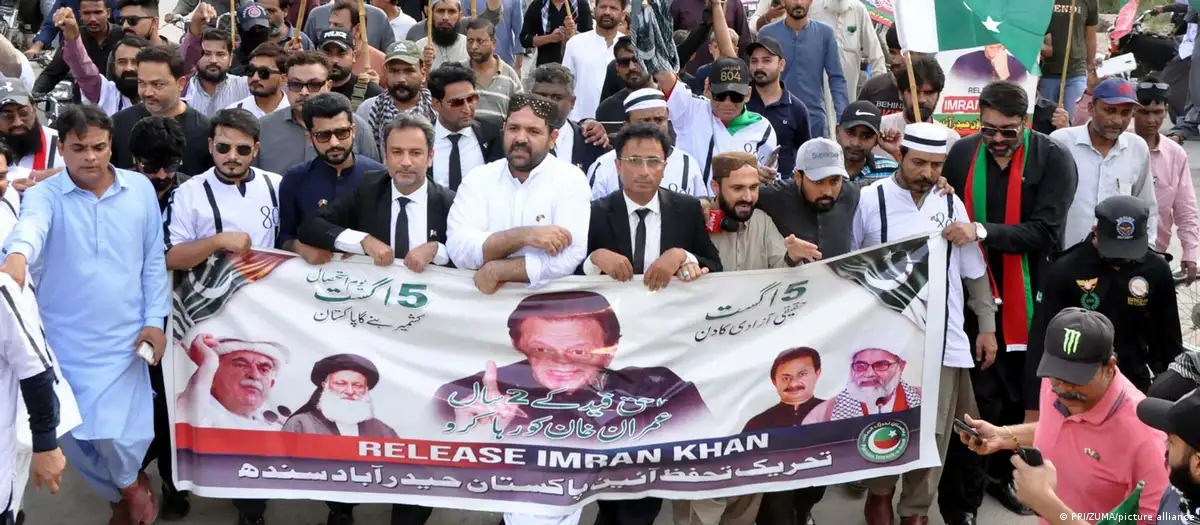
Former Pakistan Prime Minister Imran Khan’s third anniversary in prison triggered fresh political unrest across Pakistan on Tuesday, as supporters of the Pakistan Tehreek-e-Insaf (PTI) staged demonstrations in several major cities demanding his release. Police detained more than 100 PTI activists during the protests, while clashes between demonstrators and security personnel were reported in multiple locations.
The nationwide demonstrations underline that Khan’s imprisonment continues to dominate Pakistan’s political landscape even three years after his arrest. While the government described the rallies as unauthorized gatherings that disrupted public order, PTI leaders accused authorities of suppressing democratic dissent and denying fundamental political rights.
The protests also reignited concerns over Khan’s health after senior PTI leader and former federal minister Moonis Elahi alleged that the jailed leader has been denied regular meetings, adequate medical treatment and that his eyesight has deteriorated during his incarceration. These allegations remain disputed, with Pakistani authorities previously maintaining that Khan has received medical attention and denying claims of deliberate neglect.
PTI Marks Three Years of Imran Khan’s Imprisonment
The demonstrations were organized by PTI to coincide with the completion of three years since Khan’s imprisonment, a milestone the party describes as symbolic of what it calls political victimization.
Protests were reported in Islamabad, Lahore, Karachi, Peshawar and several other cities, with thousands of supporters carrying party flags, chanting slogans and demanding the immediate release of the former prime minister. In some locations, police used force to disperse protesters after authorities declared the gatherings unlawful, leading to confrontations and arrests.
According to police officials, more than 100 PTI workers and supporters were taken into custody during the demonstrations.
Despite the detentions, PTI leaders vowed that the movement would continue until Khan is released and what they describe as politically motivated cases against him are withdrawn.
Government Defends Crackdown on Unauthorized Demonstrations
The Pakistani government defended the police action, saying the demonstrations had not received official permission and posed a risk to public order.
Security forces were deployed in sensitive areas of major cities to prevent large crowds from gathering, while authorities imposed restrictions around key government buildings.
Officials argued that the measures were necessary to maintain law and order and prevent any escalation into violence.
The government’s approach reflects its broader strategy of limiting mass political mobilization since Khan’s arrest in 2023.
Critics, however, argue that repeated restrictions on PTI rallies have narrowed democratic space and intensified political polarization across the country.
Moonis Elahi Raises Fresh Concerns Over Khan’s Health
One of the most significant developments during the protests came from PTI senior leader Moonis Elahi, who alleged that Imran Khan has been denied regular access to visitors and proper medical treatment inside prison.
Elahi further claimed that Khan’s eyesight has deteriorated and accused authorities of failing to provide adequate healthcare.
These allegations echo concerns raised earlier this year by Khan’s legal team and family members, who reported that the former prime minister had suffered severe vision loss in one eye and required specialized treatment.
However, Pakistani authorities have consistently rejected accusations of deliberate medical neglect.
A government-appointed medical board previously stated that Khan’s eye condition had improved following treatment, although his family disputed those findings and continued to question the transparency of medical assessments.
The conflicting narratives have kept Khan’s health at the center of Pakistan’s political debate.
Health Becomes a Political Flashpoint
Imran Khan’s medical condition has evolved into one of PTI’s strongest political issues.
The party argues that denying timely medical care and restricting access to family members and lawyers violates both legal rights and humanitarian standards.
Government ministers, meanwhile, insist that Khan has received appropriate treatment under medical supervision and reject accusations that prison authorities intentionally endangered his health.
The disagreement has attracted attention from international observers and human rights organizations, many of which continue to monitor Khan’s prison conditions.
Although no independent international investigation has confirmed PTI’s allegations, the controversy has added another dimension to Pakistan’s already tense political climate.
PTI Keeps Its Political Base Mobilized
The anniversary protests demonstrate that PTI remains capable of mobilizing supporters despite sustained legal and political pressure.
Since Khan’s imprisonment, the party has repeatedly organized demonstrations portraying him as a political prisoner whose incarceration is intended to keep him out of electoral politics.
Political analysts believe these rallies serve multiple purposes:
- Reinforcing party unity.
- Keeping Khan’s imprisonment in national headlines.
- Sustaining pressure on the government.
- Maintaining support ahead of future political developments.
Even with many senior leaders facing legal cases, PTI continues to command significant grassroots support in several provinces.
Pakistan’s Political Divide Deepens
The latest protests also highlight Pakistan’s increasingly polarized political environment.
For PTI supporters, Khan remains the country’s most popular political leader whose imprisonment represents political injustice.
For the ruling coalition, however, Khan faces judicial proceedings under Pakistan’s legal framework, and authorities reject accusations that the cases are politically motivated.
This sharp divide has created two competing narratives:
PTI’s Position
- Khan is being politically targeted.
- Prison conditions violate his rights.
- Peaceful political activity is being suppressed.
Government’s Position
- Legal proceedings are independent.
- Public order must be maintained.
- Unauthorized protests cannot be permitted.
These competing narratives continue to shape Pakistan’s political discourse.
International Attention May Increase
The allegations surrounding Khan’s prison conditions could attract renewed scrutiny from international human rights organizations.
Previous concerns regarding restricted legal access, family visits and medical treatment have already drawn attention from global media and rights groups.
If allegations of inadequate medical care continue, Pakistan may face additional international criticism over the treatment of political prisoners and broader concerns regarding civil liberties.
At the same time, Islamabad is likely to maintain that the matter falls within Pakistan’s judicial process and domestic legal system.
Security Agencies Remain on Alert
Authorities are expected to remain vigilant in the coming weeks amid concerns that PTI could organize additional demonstrations.
Security agencies have increasingly adopted preventive measures, including restrictions on rallies, deployment of extra police personnel and temporary road closures during major political events.
Officials fear that prolonged protests could trigger wider confrontations, particularly in politically sensitive urban centers.
The government’s response suggests that preventing mass mobilization remains a key priority.
Political Implications
The latest demonstrations underscore several important political realities:
PTI Maintains Street Power
Despite leadership challenges and legal cases, PTI continues to mobilize supporters across Pakistan.
Government Prioritizes Stability
Authorities appear determined to prevent protests from evolving into prolonged nationwide movements.
Human Rights Debate Continues
Questions surrounding Khan’s medical treatment and prison access remain politically sensitive and internationally visible.
Polarization Shows No Signs of Easing
The divide between PTI supporters and the ruling establishment continues to shape Pakistan’s political environment.
What Lies Ahead?
Pakistan’s political uncertainty is unlikely to ease soon.
PTI has indicated that it will continue highlighting Imran Khan’s imprisonment as its central political campaign, while the government appears equally determined to restrict large-scale mobilization.
The next phase will depend on several factors:
- Court proceedings involving Imran Khan.
- Future decisions regarding his prison conditions and medical care.
- PTI’s ability to sustain nationwide protests.
- The government’s approach toward political demonstrations.
- International attention to human rights concerns.
Unless meaningful political dialogue resumes, Pakistan is likely to witness continued cycles of protest, police action and legal confrontation.
Conclusion
Three years after Imran Khan’s imprisonment, Pakistan remains deeply divided over the former prime minister’s fate. The latest PTI-led protests demonstrate that his detention continues to resonate strongly with supporters, while the government’s firm response reflects its determination to prevent renewed political unrest.
At the heart of the confrontation lies a broader struggle over democratic space, political legitimacy and public trust. As allegations over Khan’s health and prison conditions continue to surface—and authorities continue to reject claims of mistreatment—the issue is expected to remain one of Pakistan’s most closely watched political flashpoints in the months ahead.
Key Facts at a Glance
| Aspect | Details | Impact |
|---|---|---|
| Nationwide Protests | PTI organized rallies marking three years of Khan’s imprisonment | Keeps party supporters mobilized |
| Detentions | More than 100 PTI activists taken into custody | Raises political tensions |
| Health Allegations | Moonis Elahi alleged denial of meetings and proper medical care | Human rights concerns intensify |
| Government Position | Protests termed unauthorized; security action justified | Reinforces law-and-order narrative |
| Political Climate | Supporters and opponents remain sharply divided | Deepens national polarization |
| International Focus | Rights groups continue monitoring developments | Potential diplomatic scrutiny |